Rising research partners: how we measure who lifts their partners
Nov. 16, 2026 | By David Watkins
A different question
University rankings measure how strong a university is on its own. We asked a different question: which universities make their partners' research more influential?
When two universities publish together, the paper often reaches further than either would alone. But some universities add much more to that than others. A university that consistently lifts the research of the universities it works with is a valuable partner, whatever its place in the rankings.
This article looks at the trend: whose contribution to their partners has grown the most over the last five years.
Rising research partners
The map shows the university in each of 14 world regions whose boost to its research partners grew the most between 2016–20 and 2021–25. Each one also has a green rating on our research integrity measures.
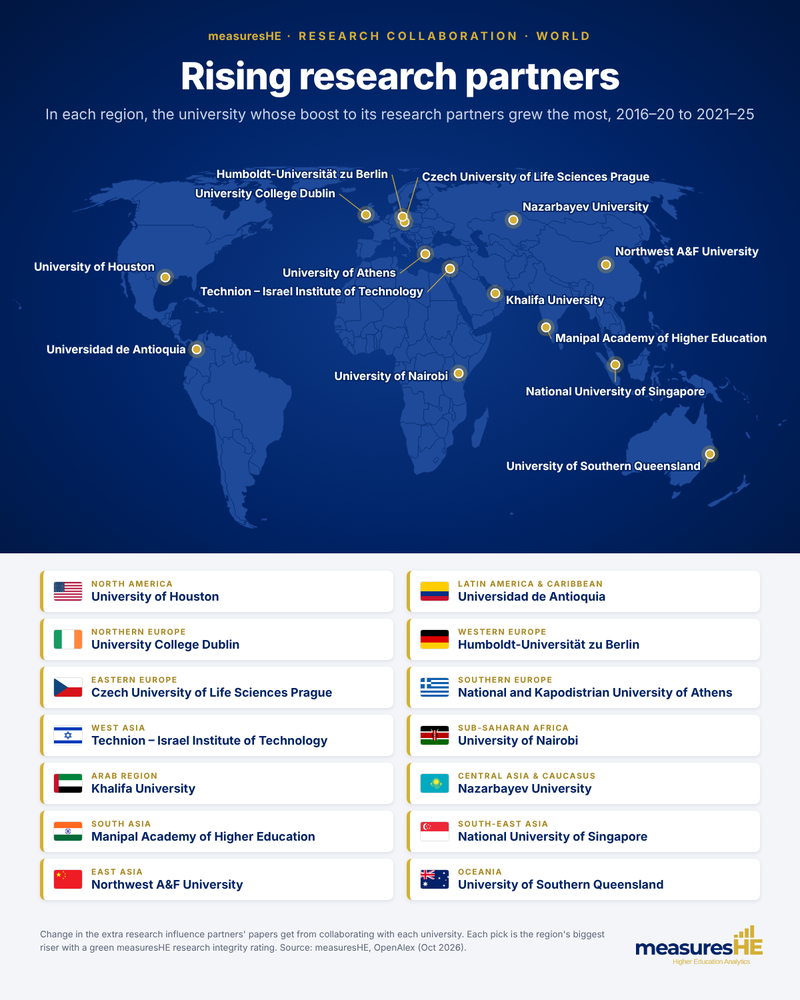
Some are familiar names from the top of the rankings; many are not. All are universities whose collaborations are doing more and more for the people they work with, from Universidad de Antioquia in Colombia to the University of Southern Queensland in Australia.
Why we look region by region
Many research partnerships are built close to home. Regional funding schemes, travel, time zones, language and the movement of staff and students all pull universities towards their neighbours. In our data, one in four international joint papers is with a partner in the same region.
So a university choosing a partner often compares the options in its own region first. Showing the leader in each region makes the results useful to universities everywhere, not just to those competing for the world's best-known names.
How we measure it
The idea. Take one university and all the universities it publishes with. For each of those partners, we compare the influence of the papers they write with that university against the papers they write with their other partners. If a partner's joint papers with University A are consistently more influential than its joint papers with others, University A is adding something.
Partner gain. Averaged across all its partners, this gives each university a single figure: how much more influential its partners' joint papers are than they would be with an average partner university. A partner gain of +28% means partners' papers with that university are 28% more influential than with a typical partner. Because each partner is compared with itself, a university is not rewarded simply for working with already-strong partners.
Rising partners. We calculate partner gain separately for 2016–20 and 2021–25. The change between the two, in percentage points, shows whose contribution to their partners has grown the most.
What counts. The analysis uses research papers from OpenAlex, the open global database of scholarly works:
- Articles, reviews, books and book chapters.
- Influence is measured by citations, adjusted for subject and year so that fields with different citation habits can be compared fairly.
- A joint paper counts only when different people from the two universities are among its authors. One person holding two affiliations does not make a collaboration.
- Very large consortium papers (more than 50 authors) are left out, and papers where the two universities are a small part of a long author list count for less.
Regions. We use the UN regions, with two adjustments so that each region holds countries with similar research systems: the Arab region (the members of the Arab League) is grouped together, and Central Asia and the Caucasus form their own region.
What it does not measure
Partner gain looks only at published research. It does not capture:
- partnerships that produce few papers, such as teaching, student exchange or joint degrees;
- the value of funding, facilities or industry links that a partner brings;
- the size of a university's research, beyond the minimum needed to be included.
It is one lens on partnership, and a useful one: it shows where joint research is reaching further than it would otherwise.
Finding the right partners for your university
The same evidence can be turned on any university's own collaborations. measuresHE Partnerships helps a university see which of its collaborations are working, and where to look for new ones:
- Which collaborations add the most. Each collaborator is rated on how much the joint research lifts quality and volume: outperforming, in line or underperforming.
- How you compare. Your collaboration portfolio is set against peer groups, from universities in your country to those just above you in the rankings.
- Who lifts whom. See which partners raise the influence of your research, and where your university is the one adding the most.
- How secure each link is. Spot collaborations that depend on one or two people, and partners with research integrity risks.
- Where to look next. Find strong potential partners that your university does not yet work with.
Tags: Academic Higher Edcuation Partnerships Research University